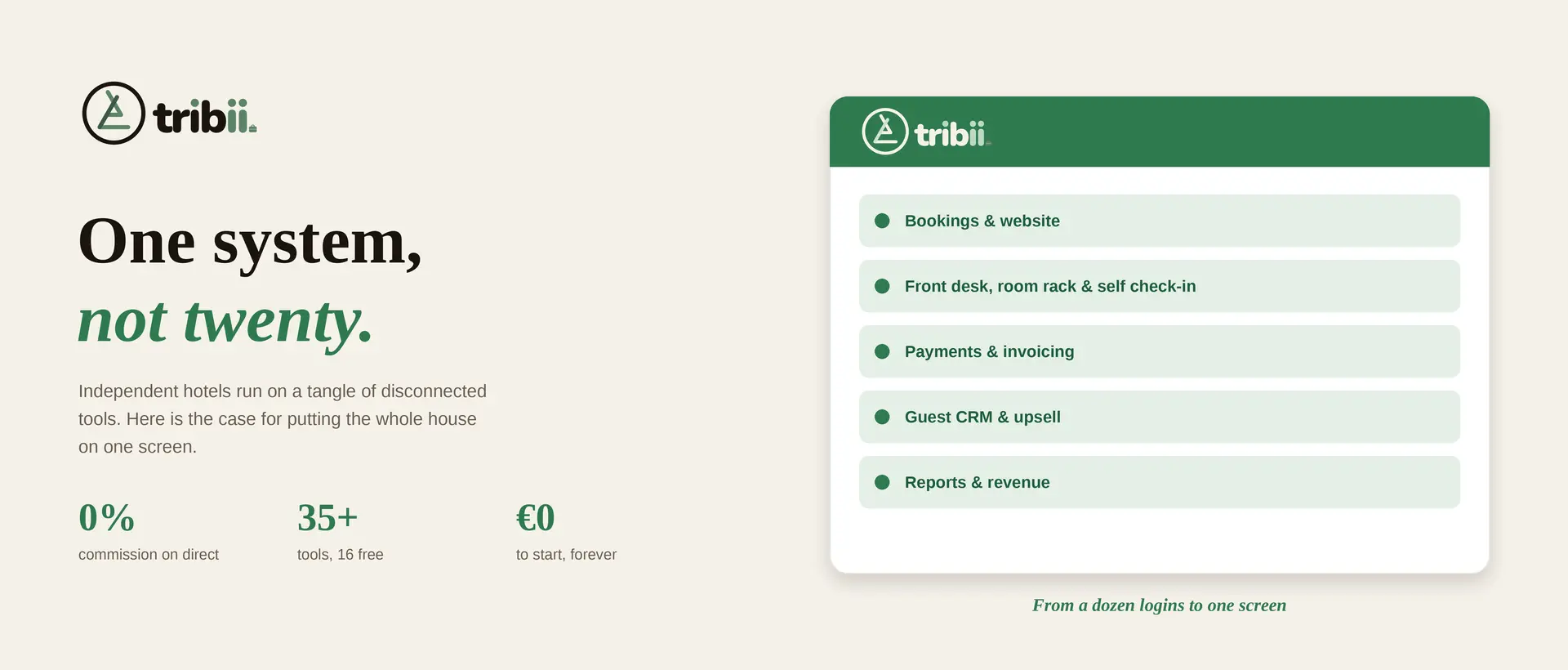
Abb. 01One screen replaces the dozen logins a small hotel juggles
Walk into the back office of almost any independent hotel and count the logins. There's the property management system, if there is one at all. The booking engine. The channel manager. A website built somewhere else, on something nobody quite remembers the password to. A spreadsheet for rates. Another spreadsheet for the cleaners. A payment terminal that doesn't talk to any of it. An invoicing tool the accountant insisted on. A separate inbox for guest messages, a separate app for the restaurant, a sticky note on the monitor for the one thing none of the systems can do.
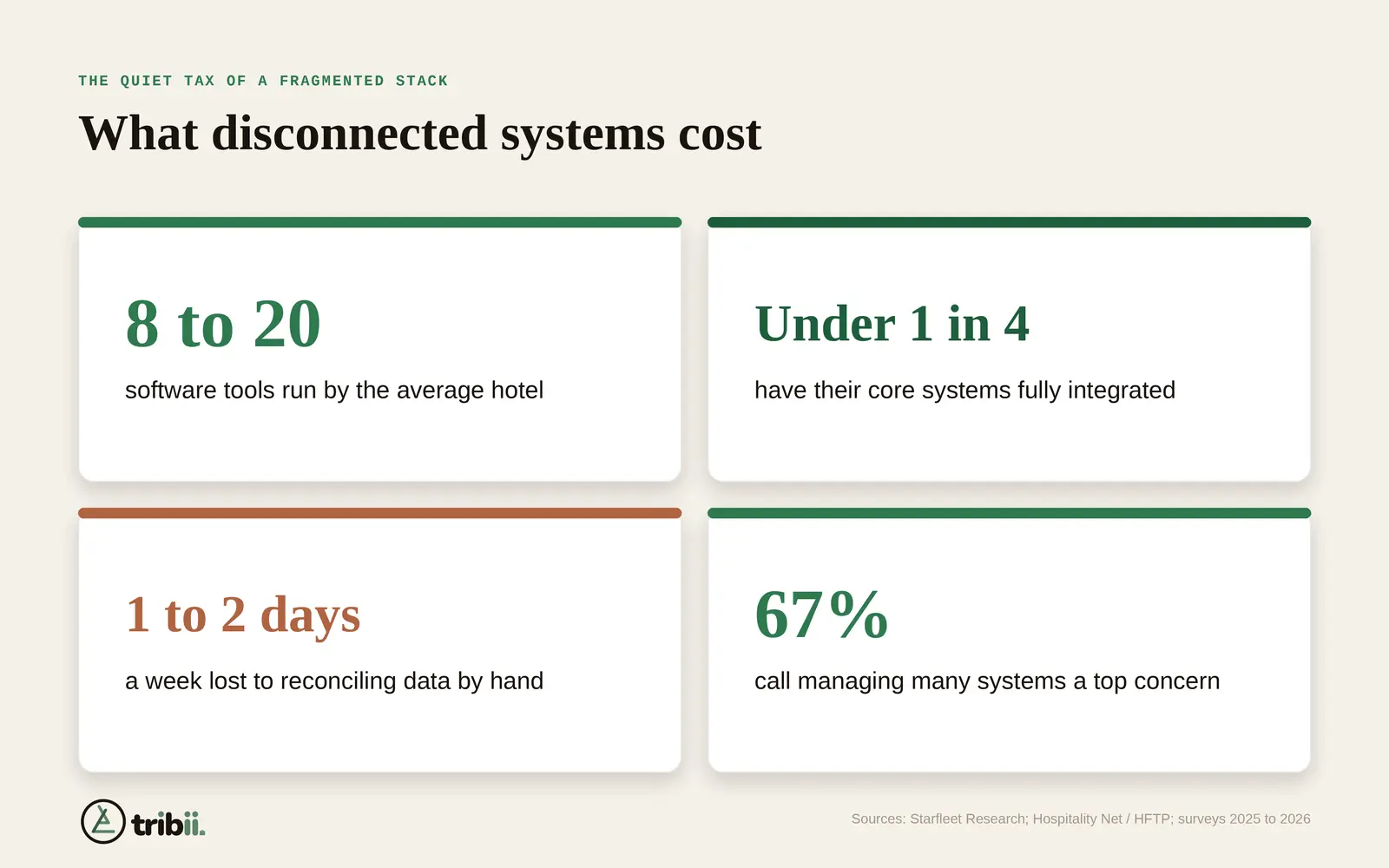
It adds up faster than anyone plans for. Industry research now puts the average hotel somewhere between eight and twenty separate software tools, and finds that fewer than one in four hotels have their core systems fully integrated. The rest are stitched together by hand, which is to say, by a person. Usually the same person who is also checking guests in.
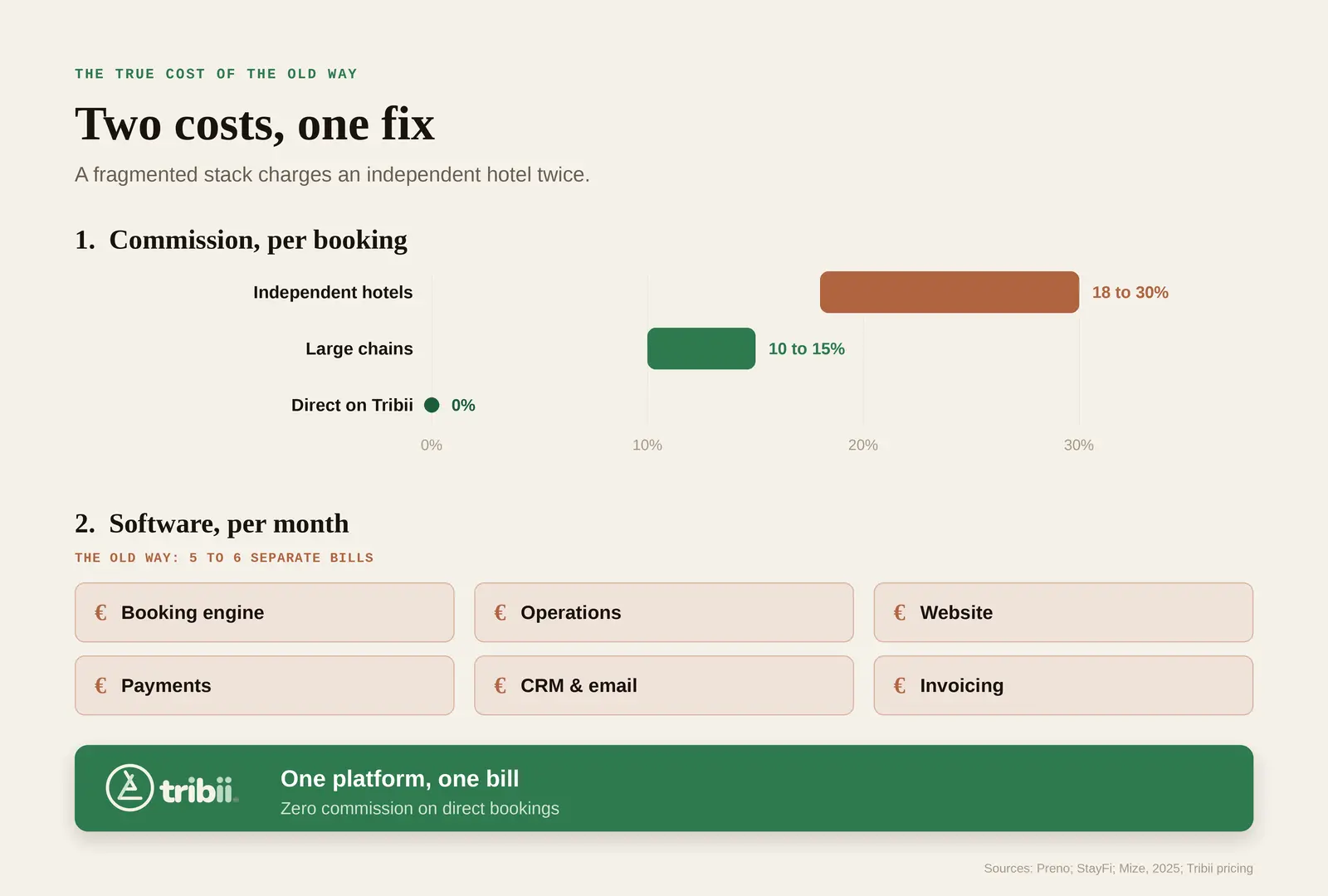
This is the quiet tax on independent hospitality. Not the dramatic line item you argue about at renewal time, but the daily friction of running a business across a dozen tools that were never built to sit in the same room. We think it's fixable. And after the commission problem, the 18 to 30% that vanishes to the OTAs before a booking ever reaches you, it's the problem we hear about most.
The cost of a system that isn't one
The fragmented tech stack looks harmless on a spreadsheet. Each tool is affordable enough on its own. The damage is in the seams between them.
Start with time. When systems don't share data, somebody re-types it. A reservation comes in on one platform and gets copied into another. The same guest exists in five places: the booking engine, the PMS, the email tool, the payment record, the loyalty note. Each spelled slightly differently, none of them agreeing. One widely cited figure has properties losing the equivalent of one to two working days a week just reconciling information across platforms. That's a day of guest-facing work, gone, every week, to copy and paste.
Then trust. The more places a number lives, the less you believe any of them. Surveys of operators find a majority can't fully rely on their own data because it's incomplete or scattered, and many can't even say where a given figure came from. When your occupancy report and your payment report disagree, you stop using both and go back to gut feel. That's a strange way to run a business in 2026.
And then the guest feels it, even if they can't name it. The booking confirmation that doesn't match the front-desk record. The upsell that never arrives because the system that knows the guest and the system that takes the payment have never been introduced. The "we'll sort it at check-in" that falls through a crack between two tools. Fragmentation isn't only a back-office headache. It leaks out into the stay.
Around two thirds of independent hoteliers now name managing disparate systems as one of their top operational concerns. The irony is sharp. The "best of breed" approach, pick the best tool for each job and wire them together, was supposed to give small properties the same firepower as the chains. Instead it gave them the integration bill without the IT department to pay it.
Why this lands hardest on the small house
A 200-room flag has people for this. A revenue manager, an IT contact, an integration budget, a vendor who returns calls. The independent down the road has the same dozen systems and a team of three, one of whom is the owner.
That's the structural unfairness we keep coming back to. The technology that's supposed to level the field actually widens it, because the cost of connecting the tools, in money, in time, in expertise, is a cost the small property can least afford and most often eats personally, at the desk, at eleven at night, with a guest's invoice that won't reconcile.
The honest answer was never "buy more tools." It was "stop needing twenty of them."
Tribii started as a free booking engine and a direct-booking website, because the commission problem was the fire to put out first. But the booking is only the front door. Behind it is the same tangle every independent hotelier knows, and so the platform has grown the way a hotel actually works, into one system that runs the whole house, for the hotelier and the guest, on a single screen.
It's worth saying plainly how much is in there now. Tribii is more than thirty-five tools and features across the platform, sixteen of them free, forever, up to twenty-five rooms. Not sixteen trial features that expire. Sixteen tools you can run a property on without paying us a cent, with the more advanced operational kit waiting for when you grow into it. The same screen a chain hotel runs on, given to the six-room guesthouse.
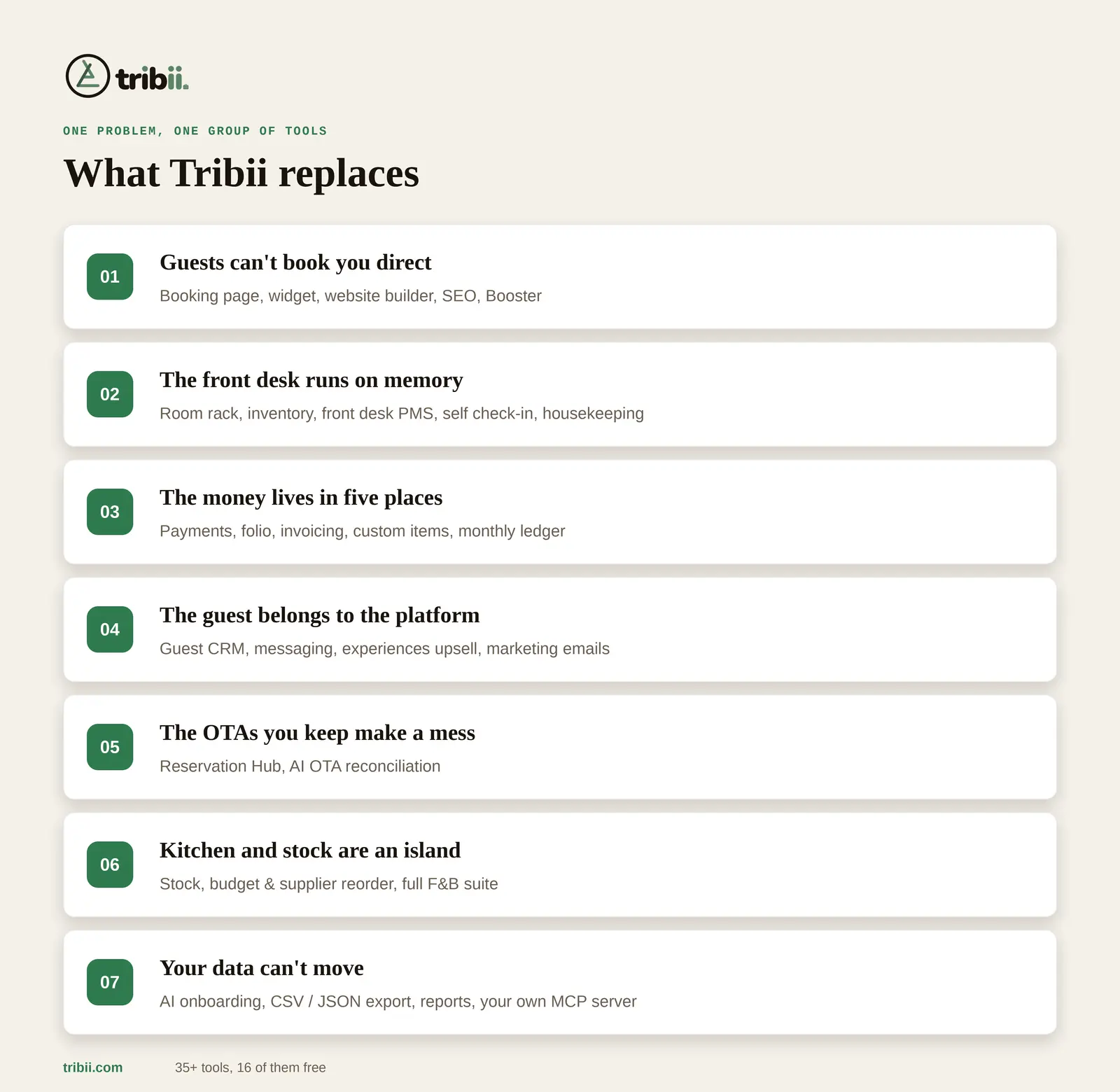
Here's the more useful way to look at it, though. Not as a feature list, but as a set of problems independent hoteliers actually have, and the group of tools that retires each one.
Guests want to book you direct, and can't
This is where most fragmentation starts. The hotel wants direct bookings but doesn't have the tools to make them easy, so the guest gives up and books through the OTA, and the cycle pays the middleman one more time.
The tools that fix it: a booking page on your own subdomain, an embeddable booking widget and search bar widget for the site you already have, a full website builder that turns your rooms and photos into a live hotel site, plus SEO optimisation and the Booster, our direct-booking engine that recovers abandoned bookings and lifts your visibility in search, so those pages actually get found and finished. That's a booking engine, a website builder, and a conversion stack, three or four separate vendors for most hotels, collapsed into one, with zero commission on every direct reservation.
The front desk runs on memory and spreadsheets
The day-to-day. Who's arriving, which room is clean, what's free next Tuesday, what broke in 204.
The tools that fix it: reservations management to confirm, modify and refund in a few clicks; a room rack calendar that shows the whole house at a glance; room inventory and rate management you can open, close and reprice by season in a tap; a proper front desk (PMS) for check-in and check-out, with a self check-in flow for guests who'd rather skip the desk; housekeeping management so the cleaners and the calendar finally agree; and a maintenance tool so 204 doesn't get sold while the shower's still broken. One operational core instead of a PMS, two spreadsheets and a group chat.
The money lives in five places
Payments here, invoices there, a monthly scramble to make the accountant's numbers match the bank's.
The tools that fix it: online payments on booking that land straight in your own Stripe (we never touch your money), a running folio on every stay with manual payments for cash or card taken at the desk, invoice management on your own template, custom invoice items, and a monthly ledger you can hand the accountant at year end. Payment gateway, invoicing software and the reconciliation spreadsheet, finally in one chain that adds up because it's all the same data.
The guest belongs to the platform, not to you
The OTA keeps the email. You change the sheets, recommend the restaurant, do the actual hosting, and then have no way to invite that guest back.
The tools that fix it: guest profiles and a CRM that remember every stay, note and contact detail; a community tool and guest app that give you a direct line to answer questions in real time; guest experiences upsell to recommend the tours and tables you love (good service, and a little extra revenue if you want it); a dedicated upsell tool; and marketing emails to bring them back next season, at your price. CRM, messaging and email marketing, usually three subscriptions, delivered as one.
The OTAs you keep make their own mess
Going direct doesn't mean going dark on Booking.com overnight. But every channel you keep is another reservation to copy in and another payout to reconcile.
The tools that fix it: a Reservation Hub that centralises and automates your OTA reservations, and an AI OTA reconciliation tool that matches their payouts to your records so you're not doing it line by line. The channel manager and the monthly reconciliation headache, handled.
The kitchen and the stockroom are their own island
For properties with a kitchen or a stockroom, that's usually a whole second software world.
The tools that fix it: stock, budget and supplier reorder management, and a full F&B suite (service board, covers, à la carte, recipes and meal-board plans) sitting on the same platform as the rooms, instead of a separate POS that never quite syncs.
Your data can't move, and neither can you
Fragmentation's final insult: even when you want to leave, your information is trapped in formats that don't travel.
The tools that fix it: AI-assisted onboarding that reads an export from your old PMS or a spreadsheet and brings your upcoming reservations, guests and payments across; data export in CSV and JSON whenever you want it, because it's yours; your overview, reports and analytics in the same place the data lives; and a growing layer of AI, monthly AI credits, AI search visibility, even your own MCP server so your hotel's data can talk to AI tools directly, with Revenue AI on the way. Centralised data isn't just tidier. It's the thing that finally makes AI useful in a hotel, because AI is hopeless in a fragmented house and sharp in a joined-up one.
What "centralised" actually buys you
Add it up and the pitch isn't "Tribii has a lot of features." Plenty of software has a lot of features. The pitch is that they're the same system, sharing the same data, so the seams that cost you a day a week simply aren't there.
A booking made on your widget is already a reservation on your room rack, a folio for your front desk, a payment in your ledger, a profile in your CRM, and a guest you can email in the spring, without anyone re-typing a thing. The guest gets a stay that feels coherent because, for once, it is. And you get your evenings back.
It's also, quietly, cheaper. Not just the OTA commission you stop paying. The five or six small subscriptions that each looked reasonable and together cost more than they should, replaced by one platform that's free up to twenty-five rooms, €50 a month when you want the advanced operational and branding tools, and €80 a month when you want the full PMS and reservation hub. A flat fee, never a cut of a booking.
Built to be one thing
We're a young company and we'd rather say where we are than oversell it. Some of this is live today and some is still being built. Revenue AI is coming, the traveller-facing side is coming. But the direction hasn't moved since day one: fewer systems, lower costs, and the guest relationship staying yours. No commission on a single direct booking, now or ever. A flat monthly price when you outgrow free, so you always know what you owe at the end of the month. Cancel, and you drop back to free and keep everything you've built.
The independent house was never short on demand. There are roughly 170,000 independent hotels across Europe and hundreds of thousands of B&Bs and guesthouses, and people genuinely want to stay in them. What's been missing is fair infrastructure: modern tools that don't require an IT department or a five-figure budget, and that work as one instead of twenty. The big chains got the software first. This is the version that finally came to the small house, and it was built to be one thing, not twenty.
So if you're reading this between two open laptops, reconciling a number that should already agree with itself: that's the part we're trying to make go away.
The best way to see it is to use it. Try the demo, free and with no commitment, and watch a booking flow through the whole house on one screen. Then count your logins, and imagine the rest of them gone.
Tribii Founder. Former bellboy turned hotel manager, transitioned to software developer. Now combining both worlds for a greater purpose: democratizing hotel software to help independent hoteliers compete with the big fish.